Category

Winckelmann

Altar of Pergamon and Baroque Scholarship

I’m in the middle of reading The Origins of the Baroque Art in Rome by Alois Riegl. This recent publication is a really exciting and influential textbook in its own right, since it is the first time that Riegl’s essays on Baroque art have been translated into English. I plan on writing a full review of the book very soon, but I just wanted to write something that I found particularly interesting.

As an introduction to Riegl’s discussion of Baroque art, this book is prefaced with three essays. These essays largely deal with historiography in regards to Baroque scholarship. It’s pretty fascinating stuff. I was particularly interested in the discussion about the excavation of the Altar of Pergamon in the late 19th century. Fragments of the altar started to arrive in Berlin in 1879 (which, incidentally, was the same year that prehistoric cave paintings were first discovered. But that’s a topic for another day. My point: 1879 was a big year for art history.)

The Altar of Pergamon is from the Greek Hellenistic period (c. 175-150 BCE). It was excavated in the late 19th century by Carl Humann, a German road construction engineer. The continuous frieze depicts the Gigantomachy (“Battle of the Giants”) with extremely high relief figures, dramatic emotional expressions, lots of diagonal compositions, and light/dark contrasts (see detail on left). Baroque scholars (such as myself) eat this kind of stuff up, since the stylistic characteristics are very similar to those of the Baroque period. I think that even the placement of the frieze near the steps (as opposed to being placed above the columns, which is the traditional location for an Ionic frieze) ties into the Baroque characteristics of viewer participation and involvement.

So, how did the arrival of the Altar of Pergamon in Berlin change scholarship on Baroque art? Before this point, the Baroque period had been viewed with some disdain by art historians and scholars. In fact, in the 18th century Winckelmann used the word “baroque” as an abusive term (and unsurprisingly, Winckelmann also disliked Hellenistic art!). But the unquestionable quality of the Pergamon frieze caused 19th century scholars to reassess their previous negative interpretations of not only Hellenistic art, but Baroque art as well. In fact, the Hellenistic period began to be known by scholars as the “ancient Baroque.”2

Consequently, because of the Altar of Pergamon’s influence, German art historians began to write about Baroque art. Heinirch Wölfflin wrote his seminal book Renaissance and Baroque in 1888, less than a decade after the Pergamon altar began to arrive in Berlin. Wölfflin even wrote in the preface “that he had intended to include an evaluation of the ‘ancient Baroque’ but that his ‘little book’ did not afford enough scope for this project, and he promised to return to it at a later date.”2 Unfortunately, Wölfflin never returned to write about the “ancient Baroque,” though other scholars (such as Arnold von Salis) did. Now, I think that Baroque scholars take the connection between the Hellenistic and Baroque period for granted. But Baroque scholarship is quite indebted to the Altar of Pergamon. Without the arrival of the altar in Berlin, perhaps “baroque” would still be a demeaning term in art history.

1 Alina Payne, “Beyond Kunstwollen: Alois Riegl and the Baroque” in The Origins of Baroque Art in Rome by Andrew Hopkins and Arnold Witte, eds. (Los Angeles: Getty Research Institute, 2010), 8.

2 Ibid.

*Image for Pergamon altar photograph © Raimond Spekking (via Wikimedia Commons) CC-BY-SA-3.0

— 6 Comments

The "Sumptuous" Arts in Greece

The quarter is over. Over the past few days I’ve reflected on what lectures I enjoyed teaching to my ancient art students. I think that my favorite lecture was based on Kenneth Lapatin’s essay, “The Fate of Plate and Other Precious Metals: Toward a Historiography of Ancient Greek Minor (?) Arts”1.

The reason why Lapatin includes a question mark after the word “minor” is important: his whole essay revolves around the argument that the Greeks valued the so-called “minor arts” much more than they are valued today. For Lapatin, the “sumptuous” artistic materials like ivory, gold, silver and gemstone were the artistic mediums that the Greeks most prized. In other words, the Greek marble, bronze and (painted) pottery (all of which are placed at the heart of Western art history) weren’t as valued by the ancient Greeks.

To prove his point, Lapatin gives one especially interesting example. He writes that “in the middle of the sixth century BC, the inhabitants of Phocaea decided to abandon their city rather than submit to the Medes. Herodotus reports, ‘They loaded onto their ships their children, women, and household property, and above all the images of the gods from the sanctuaries and other dedications, everything, in fact, except bronzes, stoneworks, and paintings, and they sailed to Chios.’”2 Now I realize that there may have been some practical reasons why the Greeks didn’t load their ships with stonework (it is heavy, after all!), but isn’t it interesting that the art we value today is precisely the art that the Greeks chose to abandon?

In some ways, this news shouldn’t come as a surprise to art historians. We have known for a long time that the main purpose of the Parthenon was to house Phidias’ chryselephantine cult statue of Athena (see above left for a reconstruction of an original of c. 438 BC). The cult statue was the most valued thing by the Greeks, not the building which housed the statue. This is very ironic, because today much more emphasis is placed on the architecture and exterior sculpture of the Parthenon. In fact, it’s interesting that one ancient Greek writer, Pausanias, only mentions the two pediments and cult statue when he described the Parthenon. He ignored the metopes and frieze completely, which suggests that they weren’t very important.3

So, why do we value painting, architecture, and sculpture above the “minor” materials and objects created by the Greeks? Lapatin traces this ideology back to Vasari’s writings of the 16th century (see a 1566-68 self-portrait of Vasari on right). Vasari’s Lives focused on the achievements of three artistic types: painters, sculptors, and architects. As a result, painting, sculpture, and architecture became “the canonical triad” in art history.4 In some ways, it’s not surprising that Vasari promoted these types of art: after all, he was a painter and architect himself. Although the effect of Vasari’s “triad” was not immediate (gems were still were considered part of the arts for a long time afterward), Vasari’s writings took part in “the displacement and demotion of items fashioned from sumptuous materials from the lofty position they held in ancient art and culture (as well as in the Middle Ages and the Renaissance).”5

Lapatin’s argument is fascinating. He also delves into interesting discussions of how Winckelmann affected our modern perception of Greek sculpture, particularly in terms of what we value today (i.e. unpainted white marble). It’s great stuff. I recommend that everyone should get their hands on a copy of this article. Unfortunately, his essay is found in a book that currently is out of print. But I promise that your efforts in securing a copy of this essay will be well worth the effort!


1 Kenneth Lapatin, “The Fate of Plate and Other Precious Metals: Toward a Historiography of Ancient Greek Minor (?) Arts,” in Ancient Art and its Historiography by A. A. Donohue, ed. (Cambridge: 2003): 69-91.


2 Ibid., 71.

3 Colin Cunningham, “The Parthenon Marbles,” in Academies, Museums and Canons of Art by Gill Perry and Colin Cunningham, eds. (New Haven: Yale University Press, 1999), 53-54. Part of the citation is available online here.


4 Lapatin, 74. It should be noted that Vasari did discuss and laud the importance of gold work and glyptic in the first edition of his Lives (1550). However, the 1568 revision of the text demoted the sumptuous arts and elevated painting instead.


4 Ibid.

— 5 Comments

The Capitoline Wolf is Medieval?!?

I don’t know how I missed this news (it’s over two years old), but I thought that I would post it for others who may not have heard. In recent years scholars have questioned whether the “Capitoline Wolf” (an iconic statue of a she-wolf that is related to the mythological founding of Rome, see left) is Etruscan. Winckelmann first attributed this statue to the Etruscan period; he based his reasoning on the way that the wolf’s fur is depicted. In turn, it generally became accepted that the statue was created in the 5th century BC.

However, a couple of scholars have questioned this attribution since the 19th century. The most recent critique was published by art historian Anna Maria Carruba in 2006. Carruba noted that in the 1997 restoration of the statue, it was observed that the she-wolf was cast as a single unit – a technique that was common during the medieval period.

Carruba’s work eventually led to radio-carbon dating tests on the sculpture. About twenty dating tests were conducted at the University of Salermo, which resulted in the announcement that the she-wolf was created in the 13th century AD! In other words, she was created up to 1,700 years later than we originally thought. Wow. Sorry Winckelmann: it looks like you’ve struck out again. Ouch.

This is a crazy paradigm shift for me. I’ve always connected the Capitoline Wolf with the Etruscans (and the Romans by extension, since she is connected with the story of how Rome was founded). I’ve always known that the Romulus and Remus figures underneath were made during the Renaissance (they were fashioned in the late 15th century AD, probably by Antonio Pollaiolo), but it’s crazy to think that the Capitoline Wolf is medieval.

I should note, though, that the attribution of this statue is still far from resolved. Not only can one get a sense of the ongoing debate here and here, but right now the Capitoline Museum still has the Etruscan date on their official website. As for me, though, I’m currently inclined to go with the radio-carbon tests and the several scholars which have questioned the attribution. (And maybe I feel this way because I often question Winckelmann’s judgment, even outside of this Etruscan attribution.)

Is this news for anyone else? Maybe I’m just behind the times. What do other people think about this new date?

— 13 Comments

My Week in Assorted Thoughts

This week I’ve been thinking about several random art historical facts and ideas. Several of you might have seen some of these links on my Twitter feed, but I wanted to flesh out a few ideas here:
  • Norman Rockwell included a portrait of Grandma Moses in his painting Christmas Homecoming (1948, see right). You can see Moses on the left side of a painting, wearing an old-fashioned dress. The two artists were friends who lived relatively close to each other at one time. (In fact, you can read parts of a story about Norman Rockwell at Grandma Moses’ surprise 88th birthday party here.)
  • I really don’t know that much about Grandma Moses. She never was discussed in any of my art history classes, but I didn’t focus on American art from the 20th century. But could she have been excluded from courses and textbooks because she is a folk artist? Out of curiosity, have any Americanists studied Grandma Moses’ work in an academic setting?
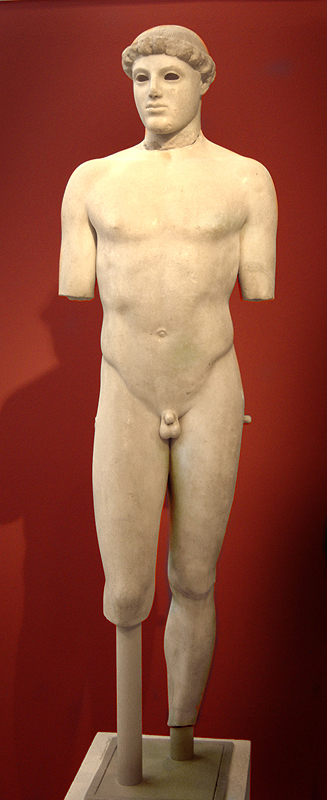
  • I was surprised to learn that Johann Winckelmann, one of the early scholars of art history, was murdered in 1768. He was fifty years old. What if Winckelmann had lived a full life? I wonder if he would have retracted any of his ideas about unpainted classical sculpture, “good taste,” or how Greek art has “noble simplicity.”1 (For example, scholars in the early 19th century were able to document the traces of paint on certain Greek statues after their excavation. If Winckelmann had lived longer, would he have learned this news and changed his ideas about white marble and beauty?) Maybe it’s a stretch, but I like to think about how the Western canon might have been different if Winckelmann had not been murdered.
  • I’ve been reading about the Laocoön statue lately, partially because I want to know more about the theory that Michelangelo created the Laocoön (which is a rather far-fetched idea, in my opinion). I’ve also enjoyed looking at this annotated chronology of the statue: this piece has a pretty rich history!
  • A comment from a student also led to me to look at a pre-20th century restoration of the Laocoön statue. This restoration depicts the arm of the priest as being fully-extended. (The restored arm (now lost) was the work of Renaissance artist Bandio Baccinelli. For those interested, Vasari wrote a little bit about Bandio Baccinelli’s work on the Laocoön here.) It appears that has been a lot of debate regarding how Laocoön originally appeared. As recently as 1989, one scholar argued that the whole composition needs to be more compact and pyramidal in order to be historically accurate.2

How was your week? Were your art historical thoughts as assorted as mine?

1 Johann Joachim Winckelmann, “Reflections on the Imitation of Greek Works in Painting and Sculpture,” in The Art of Art History: A Critical Anthology by Donald Preziosi, ed. (Oxford: Oxford University Press, 1998), 31-39. For an interesting critique on Winckelmann’s theories, see also Kenneth Lapatin, “The Fate of Plate and Other Precious Materials: Toward a Historiography of Greek Minor (?) Arts,” from Ancient Art and its Historiography by A. A. Donohue, ed. (Cambridge: Cambridge University Press, 2003), 69-91.


2 Seymor Howard, “Laocoon Rerestored,” in American Journal of Archaeology 93, no. 3 (July 1989): 417-422.

— 7 Comments

What if Sculptures Were Painted?

This week I have been reading Colin Cunningham’s essay “The Parthenon Marbles” (a preview of which is available here). Cunningham spends much of this essay examining how the bringing of the Parthenon marbles (by Lord Elgin) to the British Museum has affected the Western canon of art. (When using the word “canon” I am referring to the artistic standard and aesthetic value that has been determined by Western culture over centuries.)  The bringing of original Greek statues to England was huge, especially in the 19th century, since many artists had only known Greek art through Roman copies.  After the marbles were brought to the British Museum in 1816, thousands of artists began to study these works for their aesthetic properties.

I was most intrigued by Cunningham’s discussion of how classical sculpture continues to be left unpainted.  We know that Greek and Roman sculpture used to be painted, and many sculptures have left behind traces of paint (including sculptures on the Parthenon). Modern techniques have enabled exhibitions (such as this one and this one) to show reconstructions of how these sculptures appeared originally, such as this example of Augustus of Primaporta (right, original dated ca. 20 BC).

However when ancient sculptures were discovered, most of the paint had usually come off.  Obviously, people decided to leave the works unpainted.  On one hand, no one wanted to risk damaging the original works of art.  Plus, at the time no one knew how the paint originally appeared.  In time, though, the idea of unpainted sculpture began to be propagated by art historians as correct/beautiful/preferred, particularly Winckelmann (1717-1768), who declared that “color ought to have a minor part in the consideration of beauty.”1

So, what do you think of painted sculpture?  Does it weird you out? Cunningham points out, “If the idea of coloured sculpture seems strange to you, that shows the influence the western canon has had on all of us.”2 Personally, I like looking at painted reconstructions of ancient sculpture, because it reminds me how much the Western canon and my own artistic preferences have been constructed.  I’m sure that ancient Greeks and Romans would think it bizarre that later cultures left their sculptures white and unadorned.  And the funny thing is, we’ve continued to create unadored, unpainted sculptures for centuries, all in the name of classicism!

What if classical sculpture had still been painted when it was discovered?  That could have changed the face of the Western art – quite literally, in fact, if you think about painted faces!  Consider if Michelangelo’s David had been painted. You can get an idea of what it might have looked like from this sculpture created after Michelangelo’s David (left, by a German artist, displayed in Cologne as part of the Museum Ludwig collection).  Or what if Bernini’s sculptures had been painted?  Or neoclassical sculptures, like Canova’s Cupid and Psyche?

Art and art history could have been totally different than how they have turned out.  How do you feel about that?

1 John Hooper, “The Ancients: Now Available in Color,” in The Guardian, 22 November 2004.  Available online here.

2 Colin Cunninghman, “The Parthenon Marbles,” in Academies, Museums and Canons of Art, Gill Perry and Colin Cunningham, eds. (New Haven: Yale University Press, 1999), 70.

— 15 Comments

About

This blog focuses on making Western art history accessible and interesting to all types of audiences: art historians, students, and anyone else who is curious about art. Alberti’s Window is maintained by Monica Bowen, an art historian and professor.