Category

Middle Ages

Justinian Mosaic Altered Not Once, but Twice!


Detail of Justinian and His Attendants, wall of the apse of the San Vitale Church (Ravenna), c. 545-546. Church consecrated 547. Some alterations date c. 1100.

The mosaic “Justinian and His Attendants” at San Vitale (c. 544-545 CE) is one of the most famous works of art from the Byzantine period. It also happens to be one of my favorite piece from this era. It is commonly known that there were some alterations made to this mosaic just a few years after it was created, probably between 546 and 548. We know that the head of the archbishop (who is standing to the left of Justinian or the right side from the viewer’s perspective) was altered and the inscription Maximianus was included at this time. This change probably is because Bishop Victor was originally depicted in the mosaic. After Victor died in 545, Maximian came into power and wanted to have himself depicted instead. It is thought that Maximian needed to include his portrait as an assertion of power, since his authority was insecure at the time. In fact, around the time of this alteration the archbishop had recently been banned from entering the city of Ravenna, due to a dispute with its citizens.1

Detail of Justinian mosaic, probably depicting John the Nephew of Vitalian

Another one of the early modifications was the inclusion of a courtier who stands in between Justinian and the bishop (see above). If you look closely at the overall composition, you’ll see that this individual does not have any feet (which can be explained with the understanding that this figure is a late addition). It is thought that this figure represents John the Nephew of Vitalian, who was second in command to the commander-in-chief of Italy (the latter is thought to be depicted on the right side of Justinian, wearing a beard). Maximian may have seen potential in John the Nephew’s power, and therefore decided to include him in the composition.2 Although it does seem like it would be humiliating to be included in the background of the composition, John the Nephew did get a prime location between the emperor and archbishop.

However, in addition to these early alterations there are some other alterations to this mosaic which seem to have taken place several hundred years later, probably around 1100 CE. Isn’t that interesting? In the 1990s, scholars Irina Andreescu-Treadgold and Warren Treadgold published results on some technical analyses of the Justinian mosaic. The publications revealed changes in the scale and materials of the tesserae that were used.3 Based on these studies, I wanted to present some of the medieval restorations that took place.

Detail of deacon with tonsure, Justinian mosaic

One of the interesting additions in the c. 1100 restoration is the tonsure (shaved top of scalp) which was added to one of the deacons on the right side of the mosaic. Although the origins of the tonsure are unclear, I am not familiar with any examples of the tonsure that exist before the 7th and 8th centuries. (If anyone does know of examples, I’d be interested to learn about them!) It’s important to realize that the tonsure might not have existed in the sixth century, when this mosaic was originally made!

Detail of Justinian's crown and fibula (brooch)

Other medieval alterations include the emperor’s crown, which apparently was simplified and diminished in scale (although it is interesting to note that Empress Theodora’s crown, depicted in another mosaic in the San Vitale apse, is an original). A fibula (or brooch) was also added to Justinian’s attire in this later alteration (see above). I think that this inclusion of the fibula is rather interesting – perhaps the mosaicists wanted to visually compensate for the fact that they gave Justinian a smaller crown? Finally, the smaller pieces of tesserae at the beginning and end of the Maximianus inscription indicates that there was an alteration in this place, too.

Isn’t it interesting that we can deduce through formal and technical analysis that this mosaic was altered several hundred years after its creation? The nuanced history of this mosaic makes me love it all the more. What do you like best about this work of art?

1 Irina Andreescu-Treadgold and Warren Treadgold, “Procopius and the Imperial Panels of S. Vitale,” The Art Bulletin 79, no. 4 (1997): 721. Maximian had been barred from Ravenna because he had supported Justininan’s Edict of the Three Chapters. The inclusion of himself with the emperor in this mosaic serves to visually reinforce Maximian’s support of the emperor.

2 Ibid.

3 Ibid. See also Treadgold, “The mosaic workshop at San Vitale” in A. M. Ianucci ed., Mosaici a San Vitale e altri restaur. Il restauro in situ di mosaici parietali, Ravenna, 1992, pp. 31-41. The restoration is also briefly discussed in Sarah E. Bassett, “Style and Meaning in the Imperial Panels at San Vitale,” Arbitus et Historiae 29, no. 57 (2008): 56.

— 4 Comments

Book of Kells Folio 34 Description!

I sometimes have trouble finding satisfying discussions of illuminated manuscripts in general art history textbooks. I have found that many descriptions, while very informative about a specific illumination or artistic style, tend to focus on illuminated manuscript pages as isolated works of art. Although I realize that such isolated descriptions are part and parcel of the general survey textbook (it’s impossible to discuss everything in depth!), I still am a little disappointed. I feel like medieval gospel books were meant to be experienced as cohesive whole, not as merely isolated illuminations.

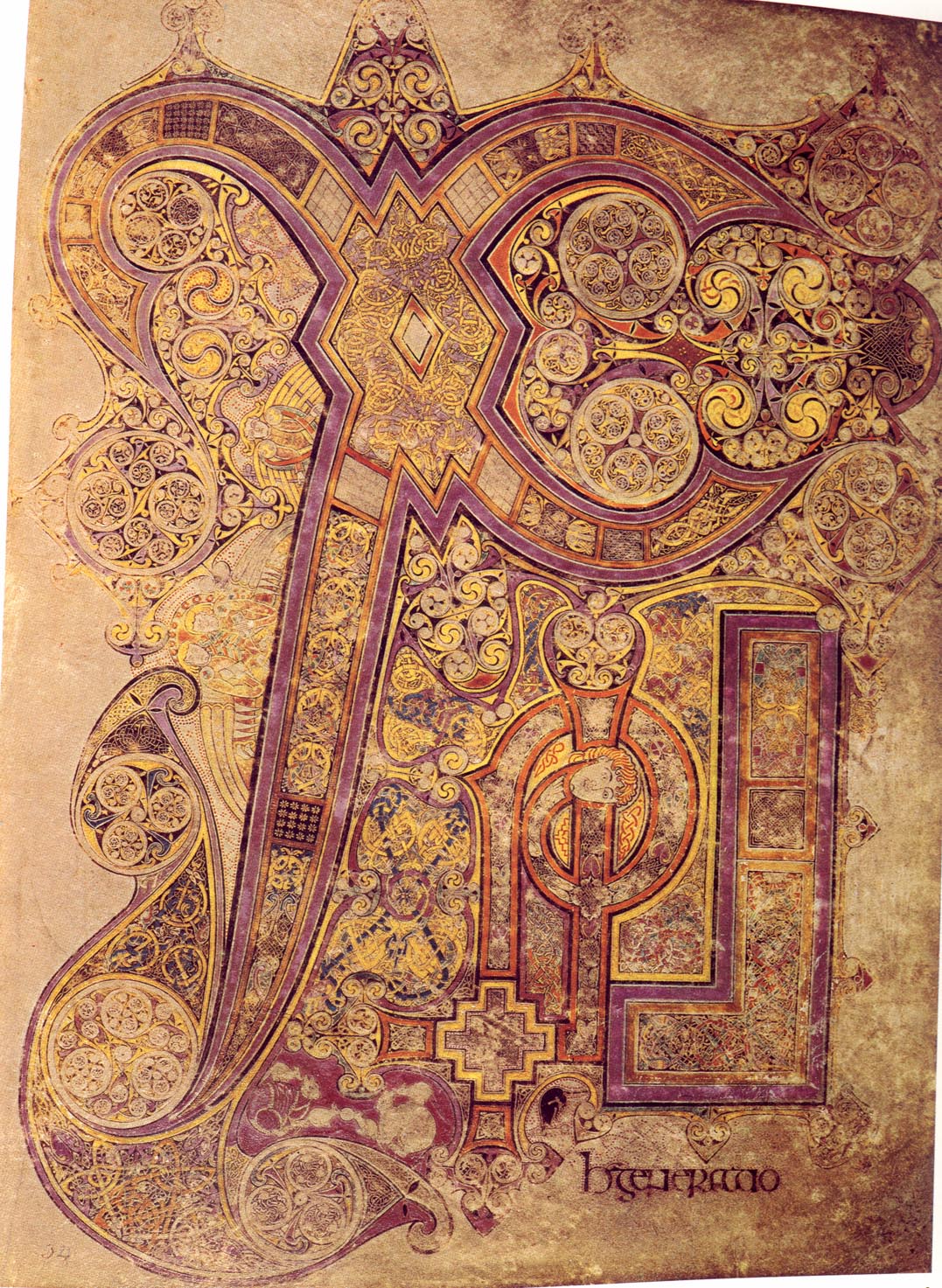
One such example of an isolated description can be found in a recent edition of Gardner’s Art Through the Ages, which discusses the “Chi-rho-iota (XPI)” page, folio 34 recto of the Book of Kells (c. 800, shown right). Although I really like that Gardner’s touches on historical context by explaining that this particular passage would be read on Christmas Day, I feel like a sense of the illustration within the biblical text and Book of Kells itself (as a whole) is relatively lacking.

This being said, I was quite delighted when I read the following passage yesterday afternoon (see below). This is one of the best descriptions of Folio 34 that I have seen in an introductory textbook. Although the passage doesn’t exactly describe the folio in relation to any other pages in the book (and, as I mentioned earlier, I realize such analysis is largely beyond the scope of an introductory textbook), I really like that the author tries to tie the decoration of the page into the actual context of Saint Matthew’s gospel:

“The earliest surviving Hiberno-Saxon religious manuscripts reveal and interest in decorating the letters themselves, a not surprising development when we remember that the words were believed to be proclamations of God. This tendency reaches its peak in the Book of Kells. When the text discussing the life of Christ in the Gospel of Saint Matthew (1:22) reaches the point where the Incarnation of Christ is mentioned, the letters burst out into joyful, exuberant patterns. This whole page is devoted to three words – Christi autem generatio (“the birth of Christ”) – with most of the page devoted to the first three letters of Christi (XPI). The X is the dominant form, and it surges outward in bold and varied curves to embrace Hiberno-Saxon whorl patterns. Interlace fills other areas, and simple colored frames set off the large initials amid the consuming excitement. The human head that forms the end of the P also dots the I. Near the lower left base of the X, a small scene shows cats watching while two mice fight over a round wafter similar to those used in the Mass – a scene surely of symbolic intent, even if its meaning is lost to us today. The pulsating vitality of the word of God is thus visually demonstrated.”1

Have you found any descriptions of illuminated manuscripts that you like? Do you know of other descriptions that help the reader to better understand either the biblical context or the folio’s physical context within the gospel book itself?

1 David G. Wilkins, Bernard Schultz, Katheryn M. Linduff, Art Past Art Present, 6th edition, (Upper Saddle River, New Jersey: Prentice Hall, 2009), 171.

— 7 Comments

St. Benedict and Thornbushes

I have a new appreciation for St. Benedict of Nursia (480-547 CE) this afternoon, just having spent a few hours pulling wild thornbushes out of my backyard. I think that is the most grueling and painful exercise I have ever had while gardening, even though I was equipped with gloves and protective clothing. But back to St. Benedict: while battling these bushes, I couldn’t help but think of the the saint. According to legend, Benedict cast himself into a thorn bush while naked, to escape the wily temptation of a woman.

When I discuss Benedict in my art classes, I sometimes joke with my students that the thornbush experience was the early equivalent to “taking a cold shower” today. (And it was, at least for some monks!) But since this morning I have a new appreciation for thornbush hoppers. Anyone who willingly throws himself into a thornbush – with the intent of getting pricked – deserves sainthood in my opinion. Definitely.

I thought it would be fun to post some images of Benedict and the thornbush. I was only familiar with a few examples before writing this post, and frankly, I’ve been surprised that I can’t find more works of art dedicated to this legend online. Perhaps monastics wanted to remember that Benedict overcame temptation, but not necessarily focus on exactly how he overcame temptation? Or perhaps there are more images that exist, but they are cloistered away from the public eye? Any medievalists have thoughts on this topic?

“Saint Benedict Overcomes Temptation” (note the devil in the center scene, who is bringing the woman to tempt Benedict) and “Saint Benedict and the Thornbush” (right), Romanesque choir capital, Saint-Benoît-sur-Loire Abbey, France, 11th century
Sodoma II, Life of Saint Benedict: Benedict is Tempted, fresco cycle from Abbazia, Monteoliveto Maggiore (1505-08)

Giovanni di Cansalvo, Saint Benedict Throwing Himself into the Thornbush, ca. 1435-39, Chiostro degli Aranci, Badia Fiorentina

Hermann Nigg, Saint Benedict Writing the Rules, c. 1926
Although I don’t think this painting is fantastic, I think it’s interesting that the artist included a thorny bush on the side of the painting. This painting depicts Benedict writing his sacred maxims and precepts; these Rules have come to be part of the foundation for monastic living in Western society.
I found another fresco described online (without an image, unfortunately) at the Subiaco Monastery, just southeast of Rome. In this fresco, Saint Francis is grafting roses onto the thornbushes into which Saint Benedict threw himself. I think that the choice of Saint Francis is especially appropriate, since Saint Francis was also known to throw himself into thornbushes to avoid sexual temptation.
The Minneapolis Institute of Arts has proposed some interesting symbolism for thorny plants, given this context of Saint Francis and Saint Benedict. It may be that in some situations thorny plants symbolized chastity and virtue, since these plants functioned as an aid for sexual abstinence!
— 5 Comments

Our Mother of Mercy and Y1K

Madonna della Misericordia, Church of San Tomá, Venice, mid 14th century to early 15th century
Remember Y2K? I can’t believe that it has been ten years since we experienced the Y2K drama and anxiety. I recall that my mom gave our neighbors hand-powered flashlights as a holiday gift that year (almost entirely in jest).
Remember how some people proclaimed that Y2K would bring the end of the world? This actually isn’t surprising, since history has shown a repeated end-of-the-world fear with the approach of a new year/century/millenium. Actually, it’s interesting to see how this fear even has affected art. I think the most prominent (and interesting) example is the imagery for Our Mother of Mercy, which displays the Virgin protectively taking her protégés/children underneath her cloak (see a late medieval example above). Henry Kraus has discussed that this iconography developed in the tenth century by the order of Cluny, “possibly in response to the terror of the world’s end that spread abroad with the approach of the Year Thousand.”1 This protective, loving image of the Virgin must have brought comfort to devout medieval worshipers who feared that the world was ending in Y1K.
Is it safe to argue, then, that the Middle Ages experienced a “Y1K”? I think so. The iconography for Our Mother of Mercy gives evidence for it! Ha!
Do you have a favorite work of art that is inspired by an end-of-the-world theme?
Having written about this end-of-the-world gloom, it seems a little ironic to wish everyone a Happy New Year. Nonetheless, I hope that this upcoming year is better and brighter for everyone. Personally, I’m not focusing on possibilities that the world will end anytime in 2011. In fact, I’ve already thought to write a post on Mayan art with the advent of 2012… ;)
Happy New Year!
1 Henry Kraus, “Eve and Mary: Conflicting Images of Medieval Woman,” in Feminism and Art History: Questioning the Litany by Norma Broude and Mary D. Garrard, eds. (Boulder, Colorado: Westview Press, 1982), 84. See also Mlle. Chatel, “Le culte de la vierge Marie en France, du Ve au XIIIe siécle,” Théses-Sorbonne (Paris, 1945): 151-52.
— 9 Comments

Crucifix of Gero Conundrum

Okay, Ottonian art experts, I need help. I’m trying to resolve an issue regarding the Crucifix of Gero (c. 970, Cologne Cathedral, shown left). The most recent editions of Gardner’s Art Through the Ages and Stokstad’s Art History mention that this statue functions as a reliquary. According to both books, a cavity in the back of Christ’s head contains a piece of the Host.1

HOWEVER, I recently read here that no cavity exists behind the sculpture. “Despite older sources even citing the exact dimensions of such a reliquary opening in the Cologne sculpture, the restoration of the Gero Cross in 1976 revealed that no receptacle exists in the corpus’ head.”2

What’s the real story behind this? Who should I believe? I’m inclined to believe the 1976 restoration news, but it seems incredulous that both major art history textbooks would have missed the “There is no reliquary cavity!” memo that was written almost 35 years ago. Did any further evidence come about after the 1976 restoration? Or should I continue to lose faith in canonical art history textbooks?

One other thought. Despite that there might not be an opening in its back, I think this statue could still function as a reliquary: in the 10th century Archbishop Gero allegedly placed the Host and True Cross in the once-cracked wood of the statue (see footnote #2 below). But I guess there’s no way to prove that miraculous story through scientific analysis, is there?

1 Marilyn Stokstad, Art History, 4th ed. (Upper Saddle River, New Jersey: Prentice Hall, 2011), 448. See also Fred S. Kleiner, Gardner’s Art Through the Ages (Backpack Edition: The Middle Ages), 13th ed. (Boston: Wadsworth: 2010), 201304.

2 Søren Kaspersen and Erik Thunø, Decorating the Lord’s Table: On the Dynamics Between Image and Altar in the Middle Ages (Copenhagen: Museum Tusculanum Press, 2006), 59 (available online here). This same book also mentions the tradition of how the Crucifix of Gero came to be a so-called reliquary: “The early eleventh century Chronicon of Thietmar of Merseburg contains a miracle story involving Gero of Cologne, who served as archbishop from 969 to 976. The passage in Chapter Two of Book Three reads: ‘Meanwhile, Archbishop Gero of the see of Cologne died. As I have only spoken briefly about him, I will not relate a few things which I previously held back. He had a crucifix artfully made out of wood, which now stands above his grave, in the middle of the church. When he noticed a fissure in the crucifix’s head, he healed it, trusting not in himself, but rather in the healthy remedy of the highest artisan. He took a portion of the body of the Lord, our unique comfort in every necessity, and part of the health-bringing cross, and placed them together in the crack. Then, prostrating himself, he tearfully invoked the name of the Lord. When he arose, he found that the damage had been healed through his humble benediction.’” See Kaspersen and Thunø, 45-46 (available online here).

— 10 Comments

About

This blog focuses on making Western art history accessible and interesting to all types of audiences: art historians, students, and anyone else who is curious about art. Alberti’s Window is maintained by Monica Bowen, an art historian and professor.