Category

art theory and philosophy

A Meaty Post

I belong to a really fantastic book group. This month we have been reading The Sexual Politics of Meat: A Feminist-Vegetarian Critical Theory by Carol J. Adams. This book is really fascinating to me. It explores how meat consumption is related to patriarchal values; meat has longstanding associations with power, strength, virility, and wealth. Adams makes some interesting parallels with how the “masculine” consumption of meat is related to the sexual consumption and objectification of women, too. (You can get a sense of the parallels made between meat and women-as-meat in Adam’s slideshow.) There is a lot more to this book too, and I would highly recommend it to anyone interested in theory, literature, or the history of vegetarianism.

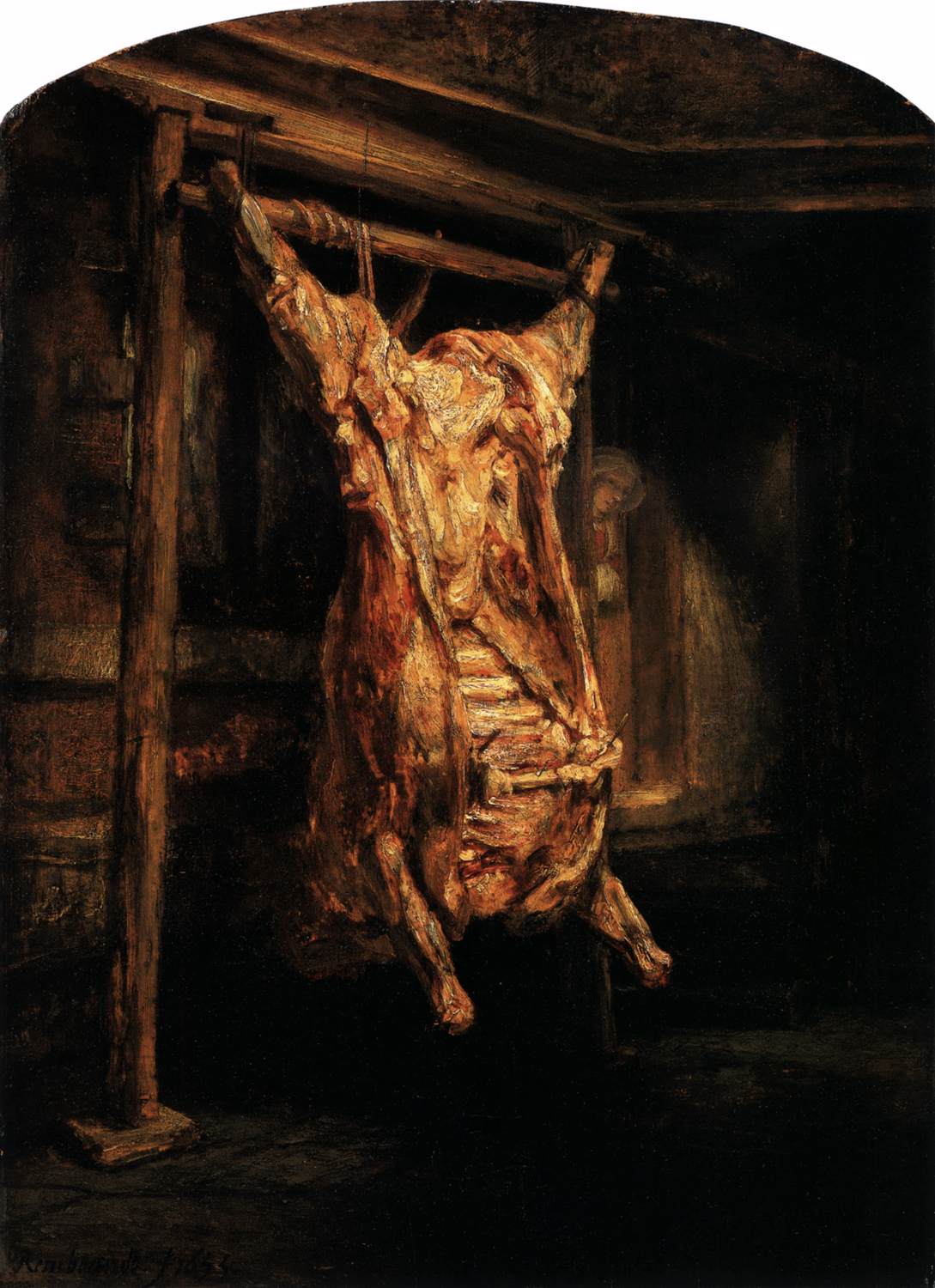
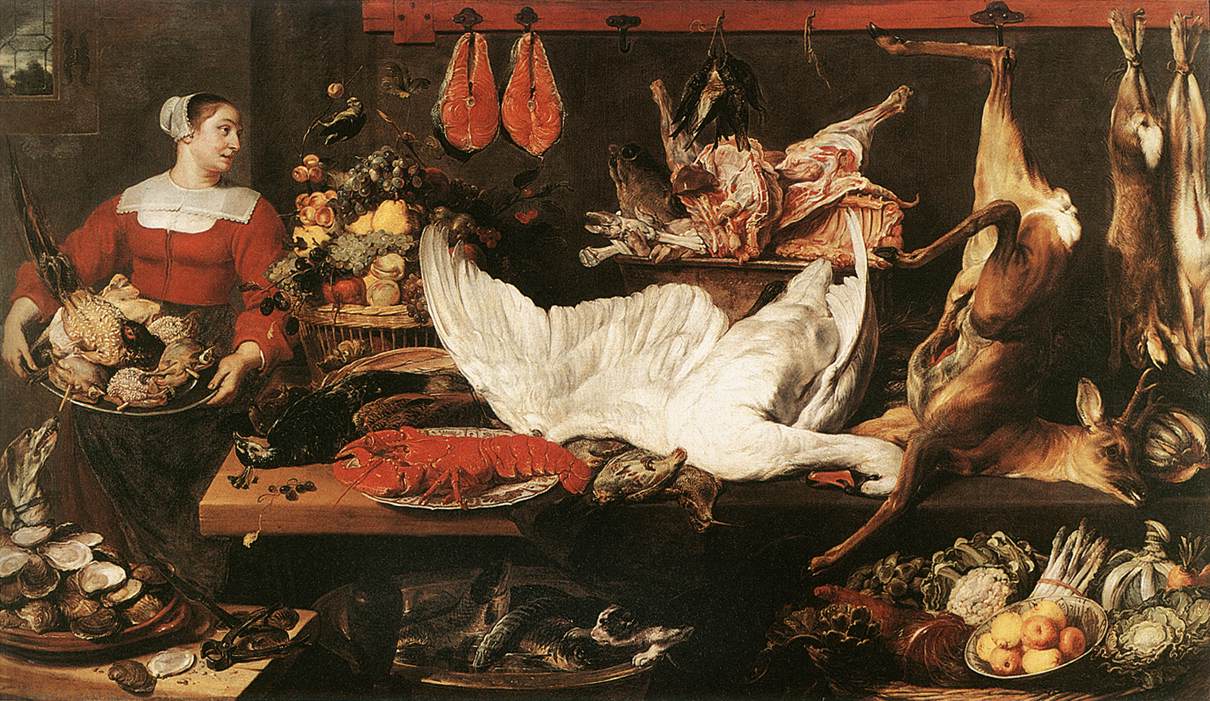
While reading this book, I continually thought of how meat is represented in art and visual culture. Although I have yet to read Adam’s other book, The Pornography of Meat, I feel like I’ve already come up with a substantial list. In many ways, the following representations of meat can also be related to patriarchy and power. I find it telling that the majority of the depictions of meat (that I have come across, at least) were created by men. And I also think it’s interesting that male artists like Rembrandt and Snyder (see below) decided to include women with the carcasses of dead animals. Are these artists merely referencing the fact that women have been delegated the responsibility to prepare meat (for male consumption)? I think we can we make deeper associations between what objects are construed for “the male gaze” in these images, especially from our modern-day perspective.

Rembrandt, "The Slaughtered Ox," 1655

Frans Snyder, "The Pantry," c. 1620

Along these lines of sexuality and male consumption, it is especially interesting to consider how Snyder depicted the maidservant with birds on a platter. The Dutch word “vogelen” (which means “to bird”) not only refers to fowl, but also to the sexual act. This painting, therefore, seems to reference worldly temptations or physical love.

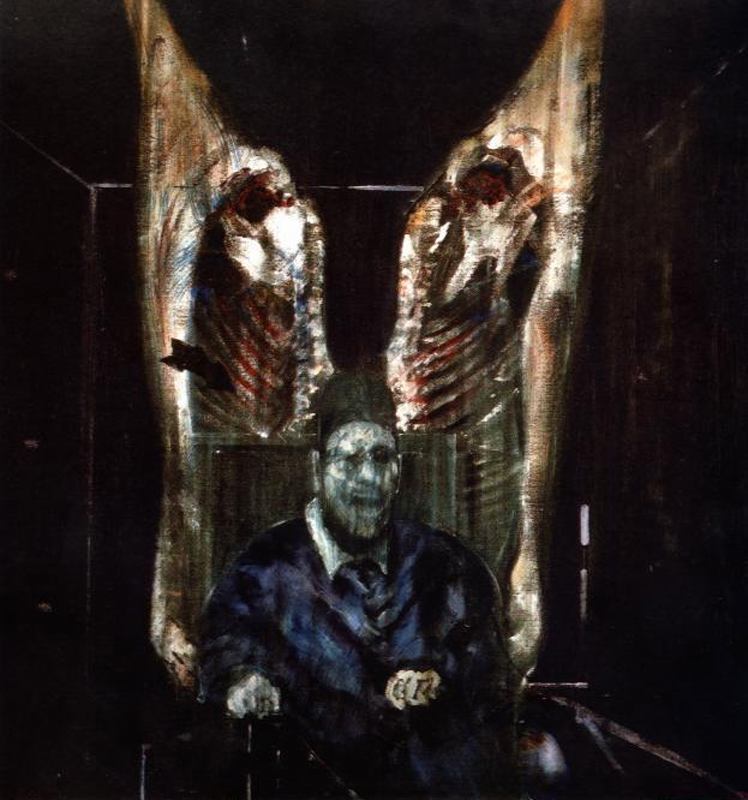
Artists in the 20th century also were interested in exploring “meaty” subject matter. One work of art that immediately comes to mind is Francis Bacon’s Head Surrounded by Sides of Beef (1954, see below). As an air raid warden in London during WWII, Bacon saw many of the horrors of war (a grisly enterprise which, I think, can be interpreted in many respects as a “masculine” endeavor). With two slabs of meat flanking the sides of a ghostly figure, Bacon explores parallels between meat and death.

Francis Bacon, "Head Surrounded by Sides of Beef," 1954

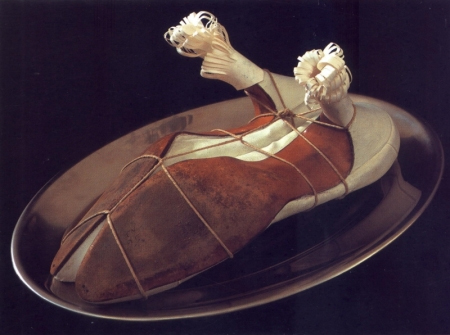
Other 20th century artists have made some interesting parallels between meat and male consumption, including the Surrealist artist Meret Oppenheim. Her work, The Governess (see below) depicts a pair of stilletto heels (objects which can signify female sexuality and arousal). The heels are tied together and decorated with paper crowns – the type of decoration sometimes found on a leg of lamb or chicken.

Meret Oppenheim, "My Governess," 1936

One of the most influential works of art involving meat is Carolee Schneemann’s performance Meat Joy (1964). This performance, which is very aggressive and controversial, involved men and women who danced, rolled on the floor, and played with a mixture of raw flesh (e.g. partially-plucked bloody chickens, raw fish, and raw sausages). The sexual connections between meat and “pleasures of the flesh” are quite clear in the performance.

I also think that it is unsurprising that audience members would squirm during Meat Joy. After all, Schneeman is including bloody and partially-plucked chickens, something that relates to what Carol Adams calls the absent-referent. When people consume animals today, the flesh is usually cooked and modified (and sometimes given a different name than the actual animal, like “veal” or “beef”) to help obscure the reality that a once-living creature has comprised the meal. So, in essence, animals are absent-referents on the dinner table. They are there, but they are also not there. Schneeman’s aggressive reference to flesh and blood in her “happenings” performance restores the absent-referent, which undoubtedly contributed to why viewers squirmed.

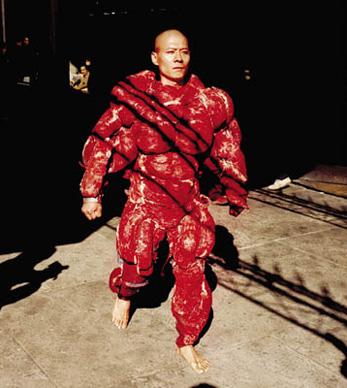
Many artists have been influenced by Carolee Schneeman. In fact, in 2008 exhibition titled Meat After Meat Joy brought together the works of various artists who have explored different meanings between meat and flesh. (You can read one blogger’s take on the exhibition here.) One of the videos on display in this exhibition was Zhang Huan’s performance, My New York (2002, see below).

Zhang Huan, "My New York," 2002. Video still from performance.

Many of Huan’s performance works involve endurance and masochism. In this particular performance, Huan walked through New York wearing a heavy suit with actual pieces of raw beef. Looking like a “beefed-up” body-builder (which alludes to masculinity and virility!), Huan would occasionally release doves during the performance.  It was interesting to interpret this performance in a political light, given the recent 9/11 attacks.  The small figure of the artist (within the powerful, beefy costume) was a reflection on how America (and New York itself) were vulnerable – as a nation and as a city.

And finally – I can’t finish this post without a pop culture reference. Lady Gaga has clad herself in “meaty clothes” a few times, once in a meat bikini on the cover of Vogue Hommes Japan. Soon after, Lady Gaga also appeared in a “meat dress” at the 2010 Video Music Awards, complete with a steak on her head (see below).

Lady Gaga's "meat dress" at the VMA music awards, 2010

Although Lady Gaga said in an interview that her dress was a statement about fighting for rights (and asserted “I am not a piece of meat”), I can’t help but see how her dress just reinforces the associations with the masculine consumption of women (which other feminists, including Carol J. Adams, have observed). In this outfit, I think Lady Gaga is suggesting that she is available for consumption on two levels: to satiate sexual and physical hunger. And because of the associations with animals and meat, Lady Gaga seems to reinforce her sexuality by suggesting that she, too, is animalistic.

Any thoughts? Have I spoiled your appetite? (Sorry!) I’m curious to see what other depictions of meat are out there. Do you know of any more? I’m also reminded of Pieter Aertsen’s two works The Butcher’s Stall (1551) and Cook in Front of a Stove (1559). Another example is Van Gogh’s Still Life with Apples, Meat, and a Roll (1886).

— 15 Comments

Titian, Mulvey, and Lacan

I’ve been on a Renaissance kick lately, haven’t I? For several weeks I have been wanting to write a post about Titian’s Venus with a Mirror (c. 1555, shown left). I think this painting is so interesting, especially because it can be applied to a few theories that are popular in art historical analysis.

I often feel a bit unsettled when looking at this painting, and it has to do with Venus’ mirror reflection. The reflection of Venus’ eye captures my attention the most. For one thing, only one eye is reflected in the mirror, causing goddess of love’s reflection to look a little bit like the Cyclops! Ha! The eye also seems to stare out of the picture plane towards the viewer (perhaps as a way to invite the viewer into the painting, as was suggested by Obridge in a comment for an earlier post of mine). This direct gaze makes the viewer extremely aware of his (the pronoun is intentional) voyeuristic gaze. (And although I don’t bring a “male gaze” to the painting, perhaps I feel unsettled because I’m a heterosexual woman; I don’t want to be accused as a voyeur while gazing at a female form!) One perceives that Venus is completely aware that her nude body is on display, since her reflected eye acknowledges the viewer’s presence.

But it’s not only the direct gaze in the reflection that captures my interest. It’s the fact that only part of Venus’ body is revealed in the reflection. Through the “cropping” of the mirror frame, Venus’ eye and shoulder become fetishized for the viewer. This reminds me so much of Laura Mulvey’s discussion of women in film. Mulvey discusses how the film camera crops and fetishizes the female form, particularly with camera close-ups on specific parts of the female body.1 It can be argued that Titian is doing the same thing, by having the mirror highlight certain parts of Venus’ body.

I wonder what psychoanalyst Lacan would say about Venus with a Mirror. Lacanian theory discusses how the mirror stage is the most important stage of development for a child (and the child’s ego) – it’s the point in which an infant recognizes himself/herself in the mirror.2 Lacan also is interested in the idea of the gaze, particularly how one develops awareness through looking.3 Given the usage of a mirror (and gaze!) in this painting, can anything be related to the mirror stage? Does the viewer feel compelled to recognize his own eye (and, perhaps by extension, his role as a spectator) when gazing at the reflected eye? Perhaps this is one reason that I feel a little unsettled; I am accustomed to seeing my own eye when I gaze at a mirror, and not the direct gaze of another person’s eye.

Lacan discusses how a young infant experiences elation during the mirror stage, for the child imagines the mirror image to be more complete and more perfect than the child experiences his own body. Obviously, the viewer can’t get a sense of completion and perfection in the mirror image that Titian has created, since Venus’ body is fragmented from the viewer’s perspective. The viewer expects to see (and anticipates that Venus also sees) a more complete reflection of the goddess in the mirror, but in actuality the more complete image of Venus (for the viewer, at least) is displayed on the left side of the canvas. Hence, I feel unsettled; the mirror has failed my expectations, yet paradoxically I am still given a “complete image” of Venus within the picture frame.

Does anyone else feel a bit unsettled by looking at this painting? Why or why not?

1 Laura Mulvey, “Visual Pleasure and Narrative Cinema,” in Screen 16, no. 3 (Autumn, 1975): 21-22. I’ve written a little bit about Mulvey’s ideas in a previous post.

2 Ibid, 17. See also “Lacan: The Mirror Stage” for further information and resources.

3 Jacques Lacan, The Fundamental Concepts of Psychoanalysis (New York: W. W. Norton, 1981), 67-78.

— 19 Comments

My Week in Assorted Thoughts

This week I’ve been thinking about several random art historical facts and ideas. Several of you might have seen some of these links on my Twitter feed, but I wanted to flesh out a few ideas here:
  • Norman Rockwell included a portrait of Grandma Moses in his painting Christmas Homecoming (1948, see right). You can see Moses on the left side of a painting, wearing an old-fashioned dress. The two artists were friends who lived relatively close to each other at one time. (In fact, you can read parts of a story about Norman Rockwell at Grandma Moses’ surprise 88th birthday party here.)
  • I really don’t know that much about Grandma Moses. She never was discussed in any of my art history classes, but I didn’t focus on American art from the 20th century. But could she have been excluded from courses and textbooks because she is a folk artist? Out of curiosity, have any Americanists studied Grandma Moses’ work in an academic setting?
  • I was surprised to learn that Johann Winckelmann, one of the early scholars of art history, was murdered in 1768. He was fifty years old. What if Winckelmann had lived a full life? I wonder if he would have retracted any of his ideas about unpainted classical sculpture, “good taste,” or how Greek art has “noble simplicity.”1 (For example, scholars in the early 19th century were able to document the traces of paint on certain Greek statues after their excavation. If Winckelmann had lived longer, would he have learned this news and changed his ideas about white marble and beauty?) Maybe it’s a stretch, but I like to think about how the Western canon might have been different if Winckelmann had not been murdered.
  • I’ve been reading about the Laocoön statue lately, partially because I want to know more about the theory that Michelangelo created the Laocoön (which is a rather far-fetched idea, in my opinion). I’ve also enjoyed looking at this annotated chronology of the statue: this piece has a pretty rich history!
  • A comment from a student also led to me to look at a pre-20th century restoration of the Laocoön statue. This restoration depicts the arm of the priest as being fully-extended. (The restored arm (now lost) was the work of Renaissance artist Bandio Baccinelli. For those interested, Vasari wrote a little bit about Bandio Baccinelli’s work on the Laocoön here.) It appears that has been a lot of debate regarding how Laocoön originally appeared. As recently as 1989, one scholar argued that the whole composition needs to be more compact and pyramidal in order to be historically accurate.2

How was your week? Were your art historical thoughts as assorted as mine?

1 Johann Joachim Winckelmann, “Reflections on the Imitation of Greek Works in Painting and Sculpture,” in The Art of Art History: A Critical Anthology by Donald Preziosi, ed. (Oxford: Oxford University Press, 1998), 31-39. For an interesting critique on Winckelmann’s theories, see also Kenneth Lapatin, “The Fate of Plate and Other Precious Materials: Toward a Historiography of Greek Minor (?) Arts,” from Ancient Art and its Historiography by A. A. Donohue, ed. (Cambridge: Cambridge University Press, 2003), 69-91.


2 Seymor Howard, “Laocoon Rerestored,” in American Journal of Archaeology 93, no. 3 (July 1989): 417-422.

— 7 Comments

Why Don’t I Like New "Masterpiece" Discoveries?

My friend heidenkind recently brought my attention to this article, which asserts that The Education of the Virgin (17th century, shown right), a painting discovered in the basement of Yale Art Gallery, is not by Velasquez (as was thought earlier this year). I have to admit, I was pretty pleased that the painting was unattributed to Velasquez. Is that strange? I would assume that most people are thrilled when they learn that a possible new work by Velasquez, da Vinci, Michelangelo, etc., has been discovered. And I rarely (if ever) feel thrilled about such news – particularly if the work has immediately been attributed to a great master. Instead, I get pleased when the painting is demoted from any “great master” status.

Lately I’ve been trying to figure out why I feel this way. Some of you may remember me earlier post along these lines, in which I discussed my skepticism on the plethora of new discoveries. I haven’t quite pinpointed all of the reasons for my skepticism/hesitation regarding new discoveries, but I thought that writing this post might help me to organize my thoughts. I think that I mostly resist hasty attributions to great masters because I know a little bit about the politics behind art attribution – it’s tempting for a connoisseur to attribute a painting to a great master, since such an attribution would help further the publicity and career of that connoisseur. I’m particularly reminded of Abraham Bredius, the connoisseur who “discovered” the “Vermeer” paintings by the forger Han Van Meegeren. Bredius is lucky that he passed away soon after Van Meegeren’s confession in 1945.

Anyhow, there are lots of other motivations for a work of art to be attributed to a great master, and most of them are financial. The owning museum, institution, or gallery will push for such an attribution, since it will be monetarily beneficial. And hey, the connoisseur could also get a nice fat check for such an attribution.

But is this political/financial reason why I don’t get excited about discoveries? I also wonder if my might have something to do with the historian side of me. If there are unknown works by great masters, then this forces me (as a historian) to reshape the artist in my mind as a historical figure. And I think I resist such reshaping a little bit. Does that make sense? In some ways, I feel like I know great artists quite well, and having a new work of art means that there is some aspect to their lives and work that was hidden from me. (I guess it’s kind of like the artist was doing something “behind my back.”) I know, it’s a little silly. Yet, at the same time, I love learning new things about artists. So maybe I experience some kind of inward struggle (i.e. the desire to learn vs. feeling deceived) when a new work of art is discovered, and that’s why I shy away from such discoveries. I don’t know.

Ironically, though, I rarely feel skeptical when archaeologists announce that a new work of prehistoric/ancient art was discovered or excavated. I always think, “Hey, awesome!” and move on with my life. So my skepticism (and emotional attachment?) must be somehow related to the idea that these works of art are attached to early modern “masters” (i.e. individuals). There isn’t enough information about specific prehistoric/ancient artists (or even some cultures!) for me to get as defensive and protective as a historian. Instead, I almost always get excited about ancient discoveries.

So, that’s what I came up with this evening: political/financial reasons and my silly protectiveness as a historian prevent me from embracing new “masterpieces.” What about you? Am I the only person who is continuously skeptical? Do most people get excited about attributions and “masterpiece” discoveries? Do any other historians get protective about an artist’s biography/oeuvre?

— 12 Comments

"Masculine" vs. "Feminine" vs. "Androgynous"

This quarter I have been peppering my lectures with some discussion about women in the visual arts, following some of the ideas that Christine Havice presented in Women’s Studies Quarterly. 1 Although art historical practice and publications have changed since Havice published her article in 1987, I think that many of her suggestions are still appropriate in the classroom today.

Recently I’ve been talking with my students about Akhenaten and the Amarna period in Egyptian art (on the left is the colossal figure of Akhenaten, c. 1353-1336 BC). This topic easily segued into a discussion (prompted by Havice) about the problematic nature of the labeling an artistic style or work of art as “masculine” and “feminine.” We discussed how our 21st century idea (i.e. construct) of “masculine” and “feminine” differs greatly (or likely didn’t even exist) in prehistoric and ancient times, and by using those labels we are superimposing our cultural ideology on a work of art. All in all, using such adjectives in art historical discussions implies that a similar “masculine” or “feminine” construct existed at the time the art was created.

Sigh. And such is the challenge for art historians. I think it is often difficult to find correct (i.e. objective) adjectives and phrases to describe works of art, because we always interpret works of our through our own cultural lenses. I’d like to think that Michael Ann Holly would agree with me on this subject, since she has much lamented the melancholic separation between historians and the objects of their scholarly discussion.

So, what do we do? Search for different adjectives? Continue to describe works of art in the best way that we know how, yet recognizing the surrounding culture from whence our biases spring? We obviously can’t ditch adjectives altogether; the discipline of art history revolves around the limited translation of images to words.

I don’t know the answers to solve such conundrums regarding adjectives, but I have formed one opinion about adjectives for the Amarna style. I think it is just as problematic to try and neutralize ground between the “masculine” and “feminine” terms by saying that Akenaten’s colossal statue “suggest[s] androgyny” (sorry, Marilyn Stokstad).2 Do we know if Akhenaten was trying to appear androgynous in his art? No! Even without using the “masculine” or “feminine” label, Stokstad is trying to define this statue on sexual grounds, in this case suggesting the lack or combination of sexual characteristics as a definition. (Besides, do we even know if the concept of androgyny existed in ancient Egypt?) I think it would have been more appropriate for Stokstad to say that the sculpture may suggest androgyny to the modern viewer.

1 Christine Havice, “Teaching about Women in the Visual Arts: The Art History Survey Transfigured,” Women’s Studies Quarterly 15, no. 1/2 (Spring-Summer 1987): 17-20.

2 Marilyn Stokstad and Michael W. Cothren, Art History, 4th edition (Upper Saddle River, New Jersey: Prentice Hall, 2011), 71.

— 6 Comments

About

This blog focuses on making Western art history accessible and interesting to all types of audiences: art historians, students, and anyone else who is curious about art. Alberti’s Window is maintained by Monica Bowen, an art historian and professor.