Category

female collectors

Hillwood Estate: Self-Portrait of an Heiress

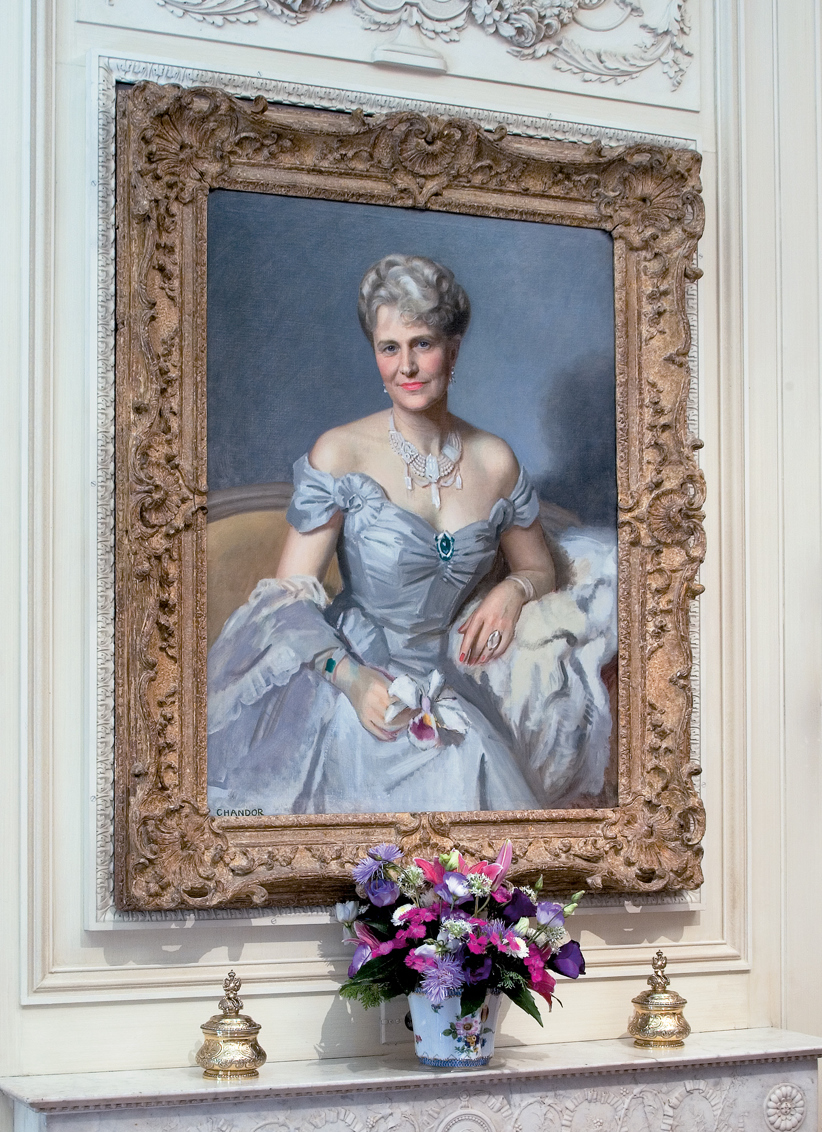
Edward Chandor, "Portrait of Marjorie Merriweather Post," 1952

How I’ve missed blogging over this past month! These past several weeks have been some of the most hectic that I have experienced in a long time. I don’t even have a Halloween-themed post for today (you can look at my Rubens and Goya posts from previous Halloweens). Instead, I want to share some thoughts on something completely different: a female collector who was interested in frothy, powderpuff, sumptuous decorative arts that are often called “feminine.” (And hey, I know that a few of you may find this art to be just as frightening and off-putting as a ghoulish work by Goya!)

Marjorie Merriweather Post was an art collector in the mid-20th century. In 1955, Post purchased the estate Hillwood in Washington, DC to house her large art collection. Hillwood is one of the “collection museums” that I listed in an earlier post. The museum has a short introduction film on their website which is as fabulous as the tag line for the museum: Where Fabulous Lives.

Early in life, at the young age of twenty-seven, Marjorie Merriweather Post became the heiress of the Postum Cereal Company (later known as General Foods Corporation) in 1914. Many biographers have commented on how Post was thrust into a “man’s world” of industry and business at a very early age.1 Several years after inheriting the family company, Post began to acquire furniture and decorative art with the help of art dealer Joseph Duveen. Interestingly, Post developed a keen interest in art during the same period in which she pushed for her business to merge with Birdeye Frozen Foods. Post’s art collection and museum can be interpreted as a self-portrait of Post, visually emphasizing her approachability, gender and femininity in order to draw a contrast with her perceived “masculine” pursuits in business.

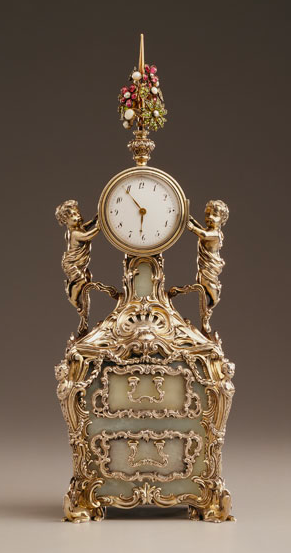
Clock, 1896, silver gilt, bowenite, watercolor on ivory. Height 11.25", width 4"

The works that Marjorie Merriweather Post collected seem eclectic and even disparate at first glance: she was interested in French decorative arts from the 18th and 19th centuries, porcelain, jewelry, objects from imperial Russia, Farbergé, costumes, and even Native American art. However, when analyzing Post’s collection, one can see the majority the collection requires the viewer to interact with the objects in a similar way. Many of the items in Post’s collection are created on a small-scale, which require the viewer to examine the finely detailed objects at an extremely close distance. It has been commented that Post was considered to be intimidating and off-putting to many people, because she gave the impression of “being very grand.”2 In one sense, Post’s art collection reflects and even extends this idea of grandeur, since the objects are very fine, luxurious, and extremely expensive. However, Post’s collection of small, dainty objects also presupposes an environment of familiarity, approachability, and even intimacy. In turn, one can assume that Post wanted to have these characteristics extended to her own persona. Post wanted her objects to be seen up close, and perhaps used these smaller objects to creatively assert that she, as an individual, was also approachable.

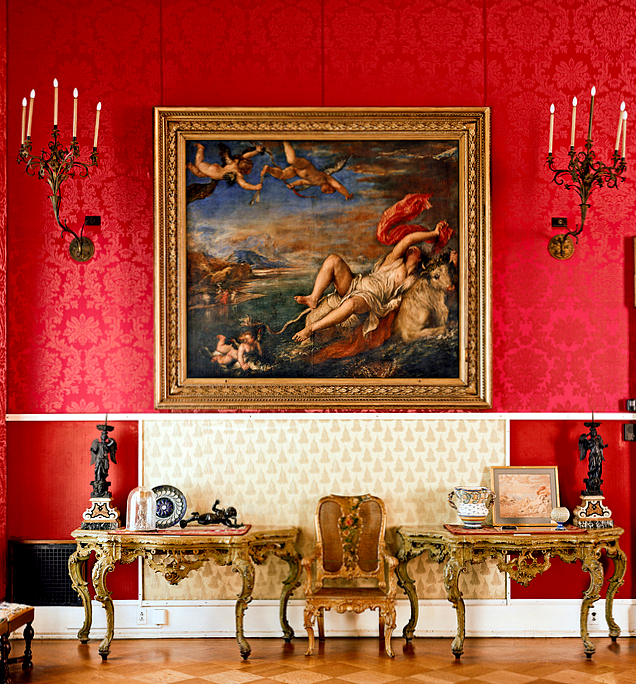
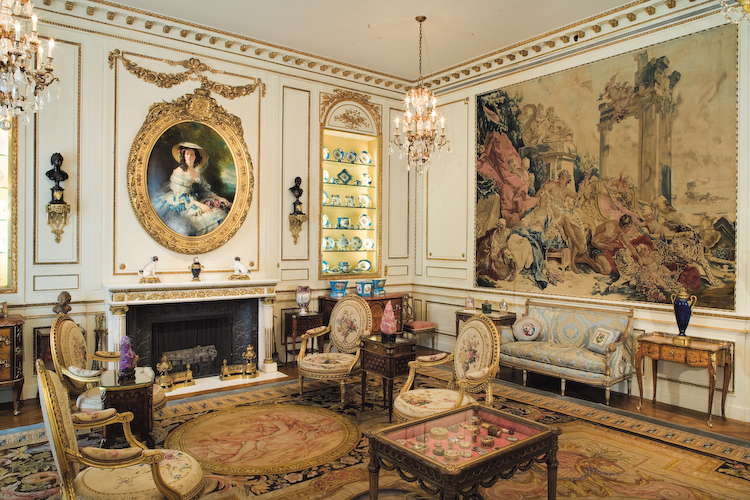
French Drawing Room at Hillwood Estate

The interior decoration and collective effect of the display contribute to the sense of femininity at Hillwood Estate. Such femininity is particularly manifest in the French Drawing Room, which is designed to “evoke the splendor of the French aristocratic life from the 18th century.” Such objects, particularly those from the Rococo period of 18th century France, historically have been considered “feminine” in nature. Art historian Melissa Hyde has stated, “During the second half of the eighteenth century, the rococo qualities exemplified by the work of [the artist] Boucher – grace, plenitude, emphasis on the seductions of color…came to be identified exclusively with the feminine.” Post includes a tapestry by Boucher in her drawing room, which compliments the flowery objects and lyrical decorative lines that suggest plenitude and grace. Such femininity can be seen in the rugs, chairs, and even the gilded molding of garlands on the wall. It is this particular room at Hillwood Estate that is decorated with many of the objects that Marjorie collected in the 1920s, the period in which she rallied to have her business merge with Birdseye Frozen Foods.

This post isn’t long enough to give a sense of the rich, luxurious quality or the expansiveness of Post’s collection- it’s quite amazing. There are many other ways that the collection and estate relate to gender, femininity, and domesticity too (I didn’t even get to the estate gardens!). Has anyone visited Hillwood Estate? What was your impression of the place?

1 For one example, see interview with Ellen Charles, granddaughter of Marjorie Merriweather Post (Hillwood introduction film at 3:39). Available at: http://www.hillwoodmuseum.org/welcome.html

2 See interview with Dina Merril, daughter of Marjorie Merriweather Post (Hillwood introduction film at 2:42). Available at: http://www.hillwoodmuseum.org/welcome.html

— 7 Comments

The "Collection Museum" Complete* List

The small “collection museum” list that I started in an earlier post has exploded into quite a large compilation, thanks to the comments from my readers! Per request, I’ve compiled this list into a separate post. This new list goes outside the chronological parameters that I used in the previous post, too. I’ve also added a two more museums: the Museé Nissim de Camondo (Paris) and Hillwood (Washington DC). As of the past week, Hillwood has taken a large role into my personal research project, since it was founded by female collector Marjorie Merriweather Post.

Walter Benjamin, when writing about collection, said that there was “a profound enchantment” in which “the thrill of acquisition” casts “a magic circle” around objects.1 Hopefully this list will provide helpful suggestions for those who like to experience such “profound enchantment” and magic in person.

The list is organized chronologically from when the museum was founded and/or opened for public view. I am defining “collection museum” as a preserved art collection amassed by a private collector, which is now on view for the public. Often, these collection museums are located in what was once the private house and/or residence of the collector.

*If you know of any other collection museums to add to this list, please let me know! I’ll try to keep this list as complete as possible.

Enjoy!

1 Anne Higonnet, A Museum of One’s Own: Private Collecting, Public Gift (New York: Periscope Publishing, Ltd., 2009), xviii.

“COLLECTION” MUSEUMS

19th century

  • 1817: National Brukenthal Museum (Sibiu, Romania). Collection of Baron Samuel von Brukenthal, which was amassed during the 18th century. Von Brukenthal stipulated in his will (which probably was written sometime around 1803, the year that Van Brukenthal died) how his collection should be treated after his death. He ordered that when the last male heir in his line of succession should die, his Late Baroque palace presenting his collections should be open to the public. These events took place in 1817. The museum was nationalized in 1948. A more detailed history of the museum is found here.
  • 1837: John Soane Museum (London). As mentioned here, the collection functioned as a museum and academy in the beginning of the 19th century. Soane was serving as a Professor of Architecture at the Royal Academy, and he allowed students to come and study his collection. Soane negotiated an Act of Parliament in 1833 to preserve the museum, and in that act was put into force when Soane died in 1837.
  • 1883: The Corsini Gallery (Rome). Collection was formed in the 18th century by the Corsini family, notably Cardinal Lorenzo Corsini (who became Pope Clement XII). Palace was sold to the Italian state in 1883 and comprised the basis for the National Gallery of Art. Official website says that “only recently” was the collection moved back to its original site at the Corsini palace.
  • 1897: The Wallace Collection (London). The collection was mainly amassed by Richard Seymoure-Conway, who bequeathed the collection to his illigetimate son, Sir Richard Wallace. Collection is displayed in the Hertford House, the main London townhouse of Sir Richard Wallace. The collection was bequeathed to the British nation in 1897 by Lady Wallace (Julie-Amélie-Charlotte Castelnau), wife of Sir Richard Wallace.
  • 1898: Musée Condé in the Château de Chantilly (near Paris). Bequeathed by the Duc d’Aumale to the Institut of France in 1897. The museum opened to the public in 1898. (Note: This museum is not the collection of one private collector, but a collection that was amassed over time by the Montmorency and Condé families. Museum also has a collection once owned by Caroline Murat, the sister of Napoleon.)

1901 – 1920

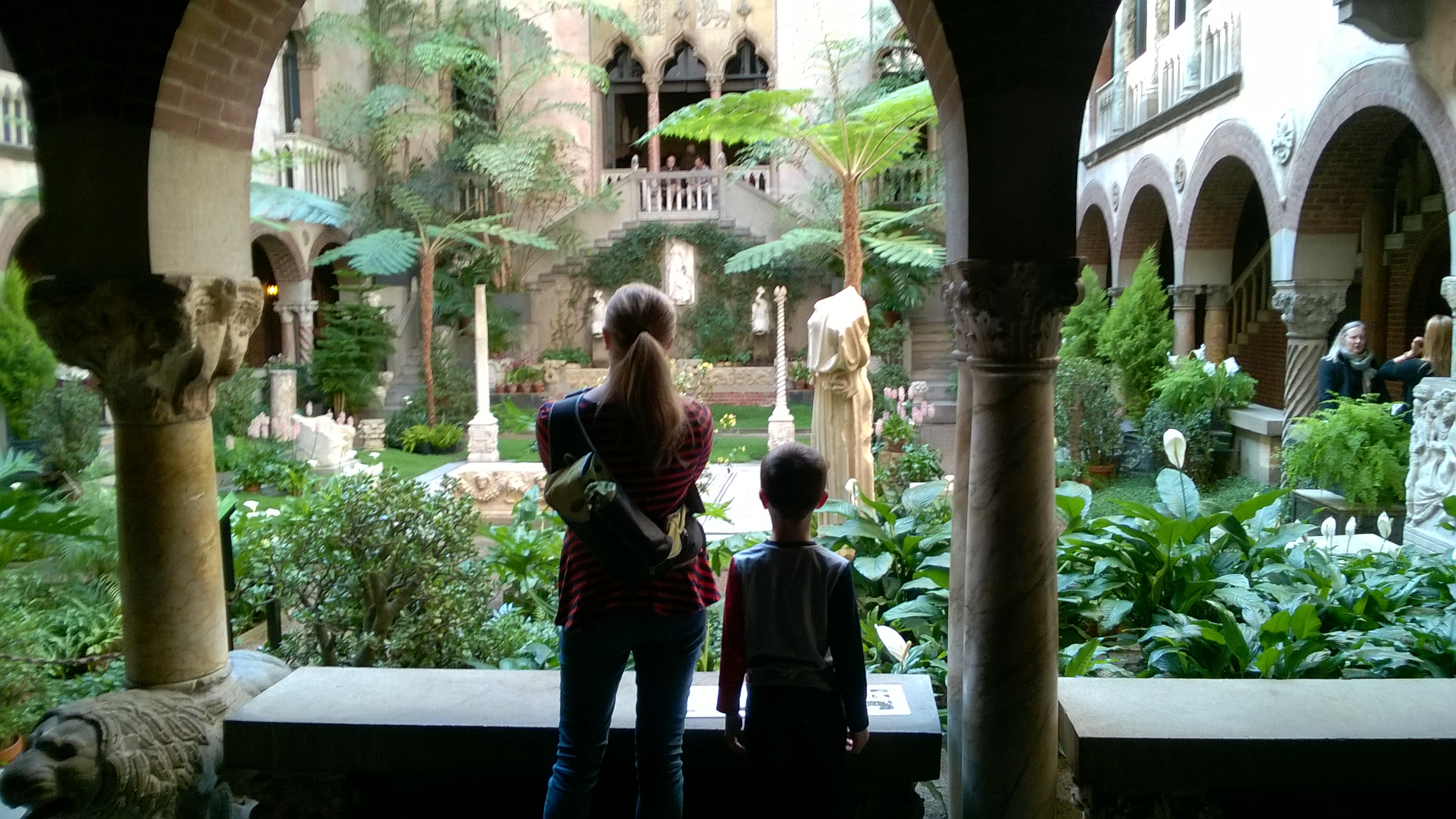
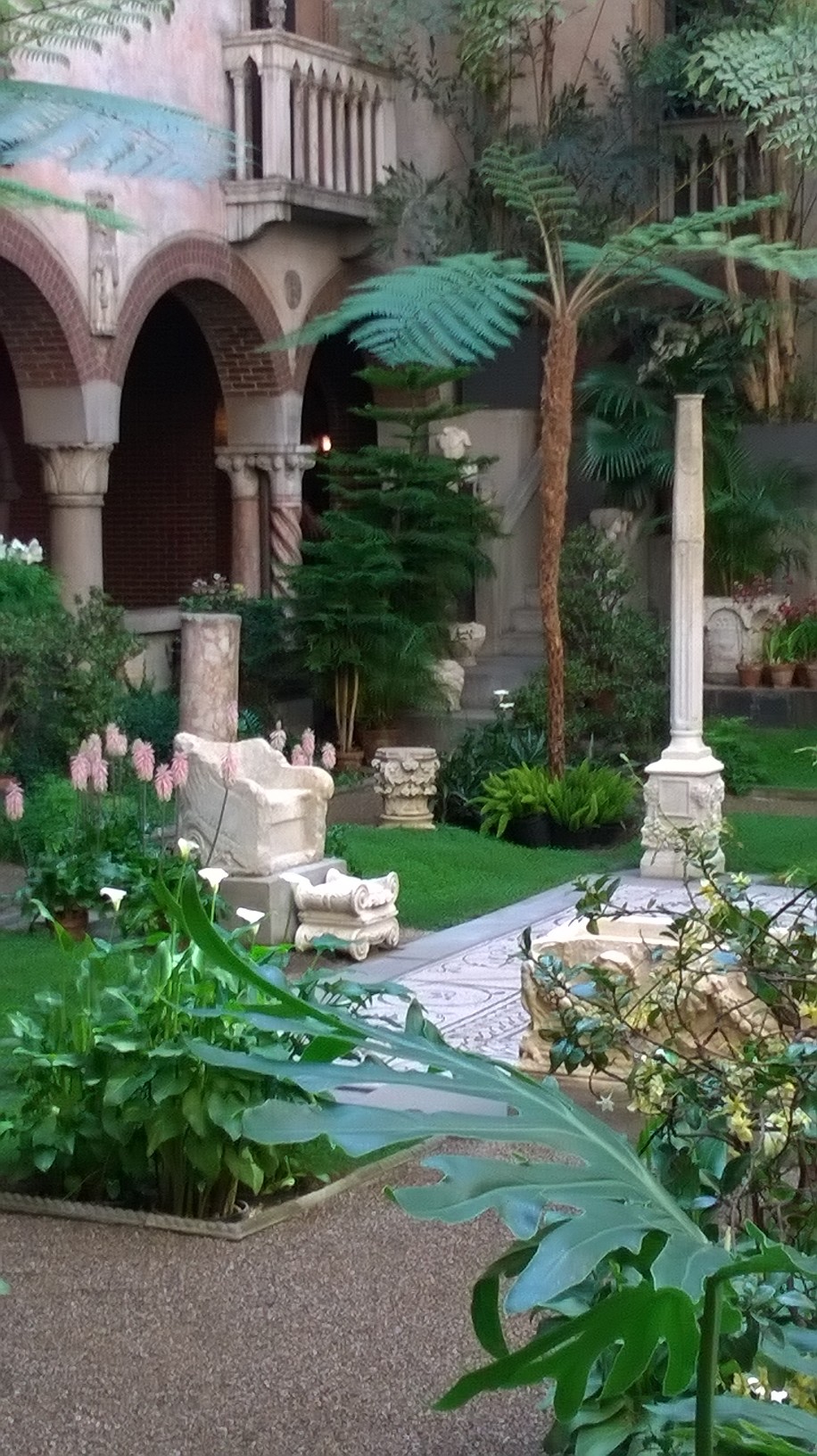
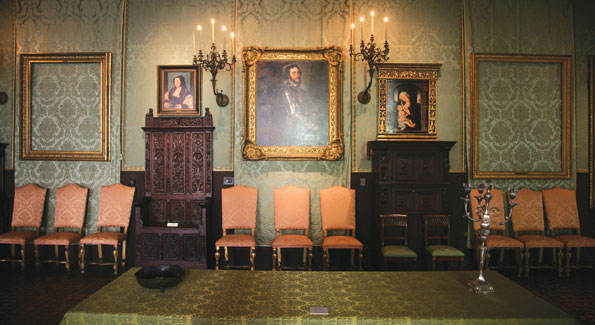
  • 1903: The Isabella Stewart Gardner Museum (Boston, Massachusetts). Collection of Isabella Stewart Gardner. The museum (“Fenway Court”) also served as Isabella’s residence. Construction begun in 1899, opened to the public on Near Year’s Day, 1903.
  • 1903: The Borghese Gallery (Rome). This gallery was the original conception and collection of Cardinal Scipione Borghese (reign 1605-1621). Housed in the former Borghese country house, this collection contains works by Caravaggio and Bernini, among others. The art collection and country house were acquired by the Italian state in 1902. The remaining parts of the villa (including parks and open-air sculptures) were ceded by the Italian state to the municipality of Rome in 1903. More information about the museum is found here.
  • 1913: Jacquemart-André Museum (Paris). Collection of André and Nélie Jacquemart. Nélie Jacquemart was a well known society painter. In accordance with her husband’s wishes, Nélie bequeathed the mansion and collection to the Institut de France. Museum opened in 1913.
  • 1920: The Hallwyl Museum (Stockholm). Primarily the collection of Countess Wilhelmina von Hallwyl. Museum is located in the Hallwyl House, which served as the private residence for Count and Countess van Hallwyl. Collection was donated to the state in 1920.

 1921 – 1940

  • 1921: The Phillips Collection (Washington, DC). Collection of Duncan Phillips. Museum building was once Phillip’s residence. Founded 1921.
  • 1921: Sinebrychoff Art Museum (Helsinki, Finland). Collection of Paul Sinebrychoff. Collection donated to the state in 1921. The Sinebrychoff private residence (the current location of the museum) was bequeathed to the state in 1975.
  • 1922: The Barnes Foundation (originally located in Merion, Pennsylvania). Collection of Albert C. Barnes. Founded in 1922. I’m especially distraught over this museum, since the collection is currently being moved to a new location in Philadelphia. If you want to learn more about the situation involving the displacement of the Barnes Foundation, I’d recommend that you see the documentary The Art of the Steal.
  • 1926: Freer Gallery of Art (Washington, DC). Collection of Charles Lang Freer. Construction begun in 1916, but gallery completion was delayed because of WWI. Gallery opened in 1926.
  • 1926: Benaki Museum (Athens). Collections of Antonis Benakis. Founded in 1926.
  • 1927: The Spada Gallery (Rome). Located in the Palazzo Spada, this collection includes 16th and 17th century paintings. The collection was largely amassed by Cardinal Bernardino Spada and his nephew, Virgilio Spada. Bernardino’s grandson, Fabrizio Spada, also added to the collection. Cardinal Spada had the Renaissance palace remodeled by Borromini in the 17th century. The Palazzo was purchased by the Italian state in 1927.
  • 1928: The Huntington Art Gallery (Pasadena, CA). Collection of Henry E. Huntington. Museum building was once Huntington’s residence. Opened in 1928.
  • 1932: The Courtauld Gallery (London). Gallery is part of the Courtauld Institute of Art. The gallery’s art collection originally contained art that belonged to Samuel Courtauld, the founder of the Institute. Courtauld’s collection contained mostly French Impressionist and Post-Impressionist works. Courtauld made a bequest to the Institute in 1948. The gallery collection has expanded to include works from several private collections, including the collection of Roger Fry (gallery received bequest following the art critic’s death in 1934).
  • 1935: Museé Nissim de Camondo (Paris). Collection of banker Moïse de Camondo. The museum is located in a mansion that was designed after the Petit Trianon in Versailles. Collection includes decorative arts, busts by Houdon, portraits by Elisabeth Vigée Lebrun, landscapes by Guardi and hunting scenes by Oudry.
  • 1935: Musée Marmottan Monet (Paris). Originally the collection of Paul Marmottan (which was partially inherited from his father, Christophe Edmond Kellermann, Duke of Valmy). Museum was bequeathed to the Académie des Beaux Arts. The museum location originally served as the hunting lodge for Christophe Edmond Kellermann and later the home of Paul Marmottan. The Academy opened the museum in 1935. Museum collection was expanded with a gift in 1957 (Impressionist collection once owned by Doctor Georges de Bellio) and in 1966 (the personal collection of Claude Monet, bequeathed by Monet’s son Michel Monet). Museum also houses a collection of illuminated manuscripts once owned by Daniel Wildenstein (who died in 2001).
  • 1935: The Frick Collection (New York City). Collection of  Henry Clay Frick. Museum is housed in the former home of Henry Clay Frick. Museum opened to the public in 1935.
  • 1936: The John and Mable Ringling Museum of Art (Sarasota, Florida). Collection of John and Mable Ringling. Museum functioned as the Ringling family’s private residence. Art collection, mansion, and estate were bequeathed to the state of Florida in 1936, at the death of John Ringling. This museum boasts an eclectic Baroque collection, among other things.
  • 1940: Maryhill Museum of Art (Goldendale, Washington). Collection of Sam Hill and Loïe Fuller. Construction of mansion (current location of museum) was begun in 1914 by owner Sam Hill. However, construction stopped in 1917. Work resumed in 1920s and 1930s, with the intent of turning the mansion into a museum. Museum opened to the public in 1940. This museum owns more than 80 works by Rodin.
  • 1940: Dumbarton Oaks (Washington DC). Collection of Mildred and Robert Woods Bliss. Museum also functioned as residence for the Bliss family. Institution dedicated and transferred to Harvard University in 1940.

1941 – 1960

  • 1944: The Burrell Collection (Glasgow). Collection of Sir William Burell, which contains over 8,000 objects. The collection is diverse; it includes medieval tapestries and paintings ranging from the Gothic era to the Impressionists. Chinese and Islamic art are also found in the collection.
  • 1949: The Gilcrease Museum (Tulsa, Oklahoma). From what I have read online, it looks like that collection was open for public view in 1949. The collection was given to the city of Tulsa in 1955.
  • 1951: Peggy Guggenheim Collection (Venice). Collection of Peggy Guggenheim. From 1951 Peggy opened up her home in Venice to the public during the summer months. Since Peggy’s death, the Guggenheim Foundation has turned her private home into the small museum of modern art.
  • 1952: Frye Art Museum (Seattle). Collection of Charles and Emma Frye. Collection contains late-19th and early-20th century European paintings.
  • 1956: Kettle’s Yard (Cambridge). Collection of H. S. “Jim “Ede. Museum was begun in 1956, after Jim Ede renovated four derelict cottages in Cambridge. Kettle’s Yard houses modern art.

1961 – 1980 

  • 1962: Mohamed Mahmoud Khalil Museum (Cairo). The museum is located in a palacethat was built in 1915. In addition to housing the museum collection, the palace also served to house government offices during the ’70s, ’80s, and beginning of the ’90s!
  • 1967: The Chester Beatty Library (Dublin). The museum is located in Dublin Castle. Collection includes books, manuscripts, miniatures, drawings and prints that were left to the Irish state. The collection has been described ”as the finest collection of manuscripts and books made by a private collector in the 20th century.” Collection objects date from early Christian to modern times. There are also Islamic and Asian manuscripts/scrolls in the collection.
  • 1969: Gulbenkian Museum (Lisbon). Collection of Calouste Sarkis Gulbenkian. Museum contains a large collection of over 6,000 pieces that dated from antiquity to the 20th century. For security measures, the collection was split up in the middle of the 20th century and sent to locations like the British Museum and the National Gallery in Washington DC. The collection was finally reunited in 1969 (after a lot of negotiation!), fourteen years after the death of the collector.
  • 1974-75: Norton Simon Museum (Pasadena, California). This museum has an interesting history, as it originally developed as the Pasadena Art Institute (1922) and then merged with the Pasadena Museum of Art (1942). Norton Simon took over financial control and naming rights for the museum in 1974-75. Simon was an art collector who was searching for a permanent house for his collection (which includes paintings of Impressionists and Old Masters). He was able to rescue the struggling Pasadena museum and find a house for his collection at the same time.
  • 1977: Hillwood Estate, Museum and Gardens (Washington DC). Collection of Marjorie Merriweather Post. Collection was bequeathed to the public in 1973, following Post’s death. The museum includes decorative arts from 18th century France and imperial Russian art.

1981-present

  • 1986: Charleston Farmhouse (near Lewes, East Sussex, UK). This farmhouse served as the country home of the Bloomsbury Group. A Charleston Trust was established in 1980 to restore and maintain the home for public benefit. The collection has been open to the public since 1986.
  • 1986: The Johnston Collection (Melbourne). Collection of William Robert Johnston. Museum contains decorative arts and antiques. Currently, the museum is located in the Fairhall house museum. The W R Johnston trust was established in 1986 to preserve and develop the collection.
  • 1987: The Royal Collection (London, Edinburgh, and Windsor). This collection has been built (and continues to grow) under the patronage of the royal family. It was begun in the 17th century, under the direction of Charles I. The Royal Collection department (established 1987) manages the public opening of the Queen’s Galleries at Buckingham Palace. There are also are exhibitions held Holyroodhouse in Edinburgh and the Drawings Gallery at Windsor.
  • 1994: Estorick Collection (London). Collection belonged to Eric and Salome Estorick. This collection contains a lot of Italian art dating from 1890 to 1950 (with an emphasis on the Futurists). Eric Estorick died in 1993, and in 1994 a Georgian house was bought by the Eric and Salome Estorick Foundation.
— 8 Comments

The "Collection Museum"

I have been doing some research on Isabella Stewart Gardner over the past few weeks, in hopes to present something at a conference this fall.

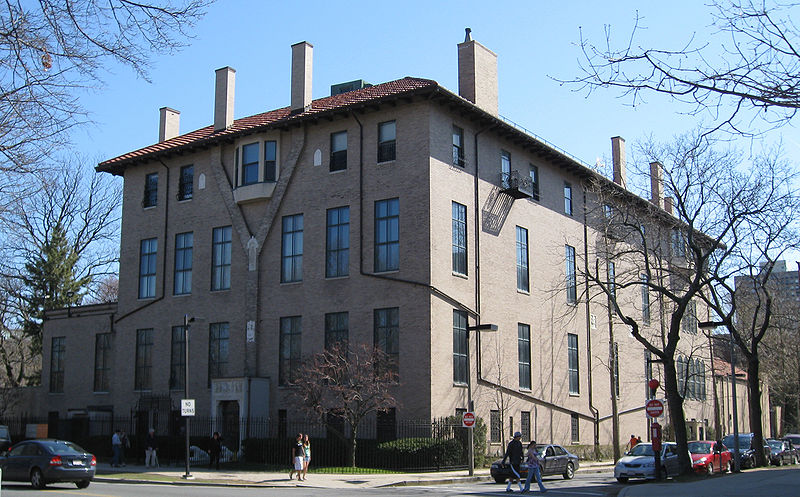
In doing this research, I’ve started to make a compilation of “collection museums” that were created by private collectors in the late 19th and early-to-mid 20th century. I love going to “collection museums,” especially when such buildings also functioned as the residence for the collector. Two of my favorite museum experiences are when I visited the Phillips Collection in Washington, DC (shown right) and visited the Frick Collection (shown below on left).

First of all, I love seeing what types of art appeal to one individual, as a collector. It is also interesting to visit these museums and see how a collector would have potentially “decorated” their residence space. (The Isabella Stewart Gardner Museum is most interesting in this respect, since she specified in her will that the arrangement and presentation of her collection could not be altered after her death, or the whole collection would be given to Harvard University.)

I think that a museum visitor can make a lot of interesting associations with works of art when they are in such a personal, domestic setting. Although great works of art can undoubtedly stand (or hang!) on their own, I love seeing works of art in an interesting context and display. “Collector museums” are fun to have in a postmodern society, don’t you think? It’s much more interesting to me than the white cube gallery space, that’s for sure.

Here are the “collection museums” that I have compiled so far (in chronological order of when the museums were built/founded):

UPDATE: A more comprehensive list (going outside the time frame from this post) was created in a separate post on this blog.


  • The Wallace Collection (London). The collection was mainly amassed by Richard Seymoure-Conway, who bequeathed the collection to his illigetimate son, Sir Richard Wallace. Collection is displayed in the Hertford House, the main London townhouse of Sir Richard Wallace. The collection was bequeathed to the British nation in 1897 by Lady Wallace (Julie-Amélie-Charlotte Castelnau), wife of Sir Richard Wallace.
  • Musée Condé in the Château de Chantilly (near Paris). Bequeathed by the Duc d’Aumale to the Institut of France in 1897. (Note: From what I can tell, this museum is not the collection of one private collector, but a collection that was amassed over time by the Montmorency and Condé families. Museum also has a collection once owned by Caroline Murat, the sister of Napoleon.)
  • The Isabella Stewart Gardner Museum (Boston, Massachusetts). Collection of Isabella Stewart Gardner. The museum (“Fenway Court”) also served as Isabella’s residence. Construction begun in 1899, opened to the public on Near Year’s Day, 1903.
  • Jacquemart-André Museum (Paris). Collection of André and Nélie Jacquemart. Nélie Jacquemart was a well known society painter. In accordance with her husband’s wishes, Nélie bequeathed the mansion and collection to the Institut de France. Museum opened in 1913.
  • The Hallwyl Museum (Stockholm). Primarily the collection of Countess Wilhelmina von Hallwyl. Museum is located in the Hallwyl House, which served as the private residence for Count and Countess van Hallwyl. Collection was donated to the state in 1920.
  • The Phillips Collection (Washington, DC). Collection of Duncan Phillips. Museum building was once Phillip’s residence. Founded 1921.
  • Sinebrychoff Art Museum (Helsinki, Finland). Collection of Paul Sinebrychoff. Collection donated to the state in 1921. The Sinebrychoff private residence (the current location of the museum) was bequeathed to the state in 1975.
  • The Barnes Foundation (originally located in Merion, Pennsylvania). Collection of Albert C. Barnes. Founded in 1922. I’m especially distraught over this museum, since the collection is currently being moved to a new location in Philadelphia. If you want to learn more about the situation involving the displacement of the Barnes Foundation, I’d recommend that you see the documentary The Art of the Steal.
  • Freer Gallery of Art (Washington, DC). Collection of Charles Lang Freer. Construction begun in 1916, but gallery completion was delayed because of WWI. Gallery opened in 1926.
  • Benaki Museum (Athens). Collections of Antonis Benakis. Founded in 1926.
  • The Huntington Art Gallery (Pasadena, CA). Collection of Henry E. Huntington. Museum building was once Huntington’s residence. Opened in 1928.
  • Musée Marmottan Monet (Paris). Originally the collection of Paul Marmottan (which was partially inherited from his father, Christophe Edmond Kellermann, Duke of Valmy). Museum was bequeathed to the Académie des Beaux Arts. The museum location originally served as the hunting lodge for Christophe Edmond Kellermann and later the home of Paul Marmottan. The Academy opened the museum in 1935. Museum collection was expanded with a gift in 1957 (Impressionist collection once owned by Doctor Georges de Bellio) and in 1966 (the personal collection of Claude Monet, bequeathed by Monet’s son Michel Monet). Museum also houses a collection of illuminated manuscripts once owned by Daniel Wildenstein (who died in 2001).
  • The Frick Collection (New York City). Collection of  Henry Clay Frick. Museum is housed in the former home of Henry Clay Frick. Museum opened to the public in 1935.
  • The John and Mable Ringling Museum of Art (Sarasota, Florida). Collection of John and Mable Ringling. Museum functioned as the Ringling family’s private residence. Art collection, mansion, and estate were bequeathed to the state of Florida in 1936, at the death of John Ringling. This museum boasts an eclectic Baroque collection, among other things.
  • Maryhill Museum of Art (Goldendale, Washington). Collection of Sam Hill and Loïe Fuller. Construction of mansion (current location of museum) was begun in 1914 by owner Sam Hill. However, construction stopped in 1917. Work resumed in 1920s and 1930s, with the intent of turning the mansion into a museum. Museum opened to the public in 1940. This museum owns more than 80 works by Rodin.
  • Dumbarton Oaks (Washington DC). Collection of Mildred and Robert Woods Bliss. Museum also functioned as residence for the Bliss family. Institution dedicated and transferred to Harvard University in 1940.

Know any more to add to this list? Have you been to visit any of these places? What was your experience? I learned about several of these lesser-known museums from a book review of A Museum of One’s Own by Anne Higonnet. I hope to read Higgonet’s book this week and add more museums to my list.

I think it’s really interesting that several women were among the first to convert their private residence into a museum space, including Lady Wallace (Wallace Collection) and Isabella Stewart Gardner. Many other women were key in forming collections, such as the Countess Wilhelmina van Hallwyl (Hallwyl Museum) and Loïe Fuller (Maryhill Museum of Art). Perhaps there was something about displaying art in a domestic space that was especially appealing to female collectors? I think that I might explore this idea further in my research!

Images from Wikipedia. Frick Collection image by Wikipedia user “Gryffindor.”

— 31 Comments

About

This blog focuses on making Western art history accessible and interesting to all types of audiences: art historians, students, and anyone else who is curious about art. Alberti’s Window is maintained by Monica Bowen, an art historian and professor.